

One of the most crucial periods in a child’s development is during his or her primary school years. This is also the period when a dyslexic child starts to show the most obvious symptoms, such as:
- Struggling to recognise or differentiate basic sight words like “the” and “ten”;
- Unable to read simple texts fluently;
- Can get 8 or 9 out of 10 marks for Spelling, but will forget how to spell those same words the following week.
Read This Too: The Most Reliable Dyslexia Therapists in Singapore
If you’re the parent of a dyslexic child who is in primary school, and if this is your first run-in with the “dyslexia” label, it’s normal to feel afraid and overwhelmed. The future may look uncertain and you or your spouse may even develop guilt, knowing that your child’s dyslexia is likely inherited.
The good news is that things will get better over time. With the right intervention, when they reach secondary school, they are more likely to do better in school and blossom into the young adult that they’re meant to be.
The bad news is that you need to help them overcome the most immediate issues in primary school first.
Potential struggles that dyslexic primary school kids may face
Transitioning from preschool to primary school can be rough for most children.
First, they are placed in classes with much larger sizes.
Second, they no longer spend as much time playing, but must instead follow a strict academic routine.
As such, the environment shifts from one that’s exploratory and experiential to one that’s competitive and demanding.
Understandably, this shift is necessary to prep kids for the real world. Many kids will struggle to adapt initially. It’s even worse for dyslexic children who have been lagging behind their neurotypical peers in literacy and language acquisition during their formative years. Thus, many of them will experience the following struggles:
They do poorly in their schoolwork
A dyslexic child’s first major hurdle is trying to keep pace with his or her peers, even though there aren’t major exams in Primary 1 and 2.
They’ll struggle to memorise spelling words, make all kinds of spelling mistakes, copy things wrongly off the board, et cetera…. It’s even worse when they have to deal with problem sums in Math, or trying to spell keywords correctly when answering Science questions.
For many dyslexic kids in primary school, it’s almost a given that they will lag behind their peers.
They get bullied or mocked regularly

As these kids struggle to keep up, they’re more likely to get made fun of by their classmates too.
It’s not really the fault of these other kids (other than them being unnecessarily mean). Most primary school kids don’t know what dyslexia is. All they know is that they have this one classmate who is so stupid that he can’t even read the word “yellow”.
But this is a reality that many dyslexic kids face, where they may get mocked for not just falling behind, but even failing to complete seemingly simple tasks.
Furthermore, it doesn’t help if the child has teachers who constantly berates them in front of others for making mistakes. Nobody likes being scolded in front of others, much less being made to feel worthless. In the long run, this can be damaging for the self-esteem.
They lose confidence in their abilities

Naturally, these students will start to question their own abilities.
“Why do I keep failing my tests/exams even though I worked hard for it?”
“Am I really stupid?”
Then over time, the questions become statements like:
“I’ll never be able to do well no matter how hard I try.”
“I give up on my studies.”
The kid tries his or her best, but the results don’t match the effort. Thus, the cycle eventually becomes a self-fulfilling prophecy, until the kid realises there’s no point to even trying anymore.
Which is such an unfortunate outcome, because many of them have the potential to do well with the right intervention!
What kind of support do primary schools offer dyslexic students?
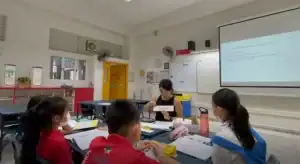
In all MOE primary schools, there is now support offered to struggling students in the form of the Learning Support Programme (LSP) and the School-based Dyslexia Remediation (SDR) Programme.
These classes are conducted by trained teachers and Special Educational Needs Officers (SENOs). They involve the teaching of literacy and phonics-based concepts, such as syllable rules and phonograms. The LSP is aimed at helping Primary 1 and 2 students, while the SDR Programme supports Primary 3 and 4 students.
For Primary 5 students who still struggle with reading, there is the Reading Remediation Programme which provides additional literacy support.
Additionally, there are counsellors in schools to support students’ social, emotional, and mental well-being.
All that said, is that enough for kids? My take is… it usually isn’t.
And I know a lot of parents would agree with me here.
Limitations of the current support structure in primary schools

A lot of kids who come to me have attended before or are concurrently attending the LSP and/or the SDR Programme. However, most tend to still be very weak in their literacy ability. Some may struggle to blend and spell monosyllabic words despite having been in the SDR programme for a while. Others may have learned more advanced concepts like vowel teams but still cannot blend magic-e (VCe) syllables properly.
It’s hard to accurately explain why this happens. It could be that the kid had been taught the concept, but not enough time was spent on reinforcing and concretising it in their long-term memory. It could also be that the concept was just not taught at all, though it’s hard to verify this solely based on the kid’s account.
The programmes are also limited to specific age groups, with LSP being limited to Primary 1 and 2 students, and SDR to Primary 3 and 4 students. Primary 5 students can still attend the Reading Remediation Programme, but afterwards they’re on their own.
In short, while it’s good that all primary schools now provide literacy programmes, many students will still fall through the cracks. Not all of them will develop the full set of skills needed to overcome their literacy and academic challenges. These students still have “gaps” in their foundation. and they will likely continue to struggle when they move on to secondary school.
How else can parents support a dyslexic child who is in primary school then?
If what MOE offers isn’t sufficient, what else can be done to support a dyslexic primary school student? Can they be pushed to do better?
The answer to the above is yes, they have the potential to do better than expected. Here’s what you can do to support them.
Find a good intervention programme for your child

The first step is to get them help elsewhere, either as an alternative to the LSP and SDR Programme or to complement them.
There are many therapists and tutors in Singapore offering help, and it’s understandable if all this gets too overwhelming for you. But here are some things you can look out for:
- Does the therapist use or adopt at least one reliable methodology, like Lindamood-Bell or Orton-Gillingham?
- Does the therapist give off good vibes that suggest he/she can build rapport with your child?
- Can the therapist explain how he/she will help the child in specific areas, for example in reading comprehension or vocabulary cloze?
If the answer to all of the above questions is “yes”, then that’s a therapist you should shortlist.
However, it is important to bear in mind that while a good therapist can help your child maximise their potential, there are many variables that can affect their exam performance. They could freeze up, suffer from panic attacks, etc. Thus, it is also important to help them understand that while the PSLE is important, it is just a small cog in the grand scheme of things.
See Also: What to Take Note of When Choosing a Therapist for Your Child
Let them know the PSLE isn’t the end-all-be-all
Employers aren’t just looking at results anymore, they’re also looking for potential hires who are emotionally stable and resilient.
Some of my ex-students had done poorly for their PSLE and had to join the Normal (Technical) stream (what is now called G1) in secondary school. Some of them are now in institutions of higher learning (IHLs) pursuing their diploma or degree.
The PSLE does play a part in determining what secondary school a child can join and which posting group they’ll be assigned to. That will certainly influence how they grow their skills over the next 4 years, which will then affect their choices when moving on to IHLs.
However, that aside, there are other important matters to worry about. One, is your child equipped with values like social awareness and resilience? Two, is your child motivated to improve?
These are areas you’ll want to work on, because it determines how well your child can deal with hardships, especially in times of uncertainty. Employers aren’t just looking at results anymore, they’re also looking for potential hires who are emotionally stable and resilient.
I know this because I’m an employer myself.
Therefore, help them work on what they can control
Primary school kids are still at that vulnerable age where they can be easily led astray, made to believe stupid things and follow absurd trends or memes that they see online.
Take this opportunity before your child starts going into full-blown puberty to help them develop values and find direction. Work on your relationship with them so that they see you as a confidant and friend.
I’m telling you right now, if you miss this opportunity in primary school, it’ll be one heck of an uphill struggle to do all of these when they’re in secondary school.
But, if you do all these while they’re still impressionable and affectionate, the payoff will be greater than you can ever imagine. When they come of age, they’ll be independent, ambitious, and emotionally sturdy young adults.
Work on your child’s academics, but don’t neglect other important aspects of their development
Dyslexic primary school kids have the potential to do well with the right help. Some can overcome their challenges after going through the LSP and SDR Programme. Others may need external intervention like educational therapy and speech therapy.
But, again, academics are just one part of the child’s development. Never forget that the primary school age is the best time to foster good relations with your child, to help them discover themselves, and to build up their character. Even if they don’t do as well as expected for their PSLE, they would still be able to grow in the right direction. It is better to bloom later than to not bloom at all.
Follow Swords & Stationery on Facebook, Instagram, and LinkedIn to stay up-to-date on our latest learning tips, strategies and discussions.